

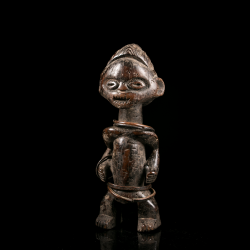
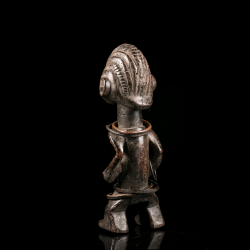


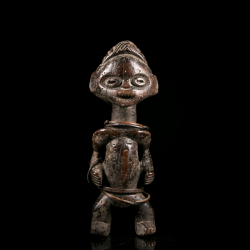

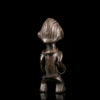
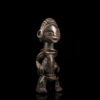
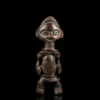
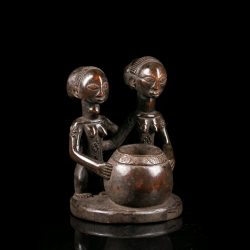
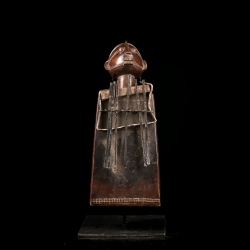
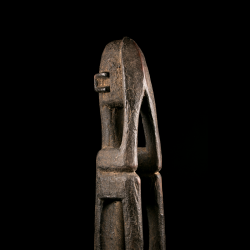
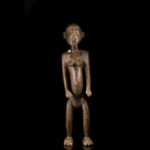
Originating from the Ngbaka people of northern Democratic Republic of Congo, this Yanda figure belongs to one of the most spiritually meaningful sculptural traditions of Central Africa. Carved with deliberate stylization, its expressive face and simplified body reflect the Ngbaka artistic language, where essence and symbol prevail over naturalism.
Among the Ngbaka, sculpture holds a privileged place, and small ritual figures such as this one play a central role in social and spiritual life. These statuettes are particularly linked to the Mani secret society, an institution shared with neighboring Zande communities. Within this context, Yanda figures were used during initiation ceremonies and ritual practices intended to protect individuals from misfortune, illness, and harmful forces.
Often associated with protective and feminine spiritual powers, they served as mediators between the visible and invisible worlds, ensuring balance, fertility, health, and moral guidance within the community. Their ritual nature also gives them an ephemeral destiny: once their purpose was fulfilled, many were intentionally discarded or broken, reinforcing their functional rather than purely decorative significance.
Beyond their ritual role, Yanda figures bear witness to the deep cultural identity of the Ngbaka. A people whose traditions trace back to migrations from the Nile Valley as early as the 17th century, they have maintained rich practices centered on agriculture, hunting, metalworking, dance, music, and an important oral heritage.
This piece exemplifies the symbolic intensity, sculptural refinement, and spiritual dignity that define Ngbaka ritual art, making it a meaningful addition to any serious African art collection.
Reviews
There are no reviews yet.